Easy Things to Kill on Ark Scorched Earth
All the tips you need to survive in the ruthless, merciless world of ARK: Survival Evolved.
- For a Beginning Game Guide see Getting Started.
- Also have a look at Building Guides or the list of all available guides on this wiki.
General Tips [ ]
Inventory Management [ ]
Learning how to manage or sort your inventory can help you in the long run.
This section contains several advices that may not be perfect for you, depending on your playstyle, weight levels, and available resources. But for the most part, the information is helpful.
When it comes to your inventory, there are some things that are always prudent to be kept, no matter what you're doing. You never know when a potential tame, dangerous dino, rare resource, etc. may come across your path. So be sure to always, if possible, to include the following:
Travel [ ]
Hunting Strategies [ ]
- Using tamed carnivores like Raptors, Carnos, and Rexes are a good way to hunt for meat and hide but make sure your creature of choice is capable of handling your prey of choice.
- You can lure carnivores to other dinosaurs and leave them to fight each other, leaving you with a weaker dinosaur and free resources.
- Knocking a dino unconscious can be quicker than going straight for the kill.
- Keep an eye on nearby herbivores. If you see them running, they are either fleeing or fighting a nearby predator.
- Crafting
 Bolas is a great hunting tool to both capture or escape from small legged dinos hunting you such as
  Raptors.
 - Every beginning Survivor should have
 Spears in their possession for both defending and hunting.
 - When in the inventory of a creature or container, hover over an item and press T to easily transfer that item to your own inventory, or vice-versa.
- To get early meat and hide, kill passive and slow creatures like Dodos, Jerboas, Bulbdogs as they don't fight back, it is also an easy source of early game experience. Simple weapons like Spears, Bow and Arrows, and Tools are good to kill these small targets.
Environment [ ]
Shelter [ ]
- It's recommended to make a
 Hide Sleeping Bag at an early level - it displays map coordinates to aid navigation, may be picked up and re-placed, and is handy for marking caves or other points of interest. A sleeping bag does not require a structure to be built upon, but cannot be shared by tribe members and is a single use item. Change to
  Simple Bed when you can.
 - Having a simple shelter can be a lot more useful than you would think. You could easily find yourself freezing and starving on a cold night.
- When building walls, use E ,
 , or
, or  to toggle the direction the wall is facing.
 - Don't build shelter too close to the water, there are sea dinosaurs that can destroy the earliest shelter easily.
- You can upgrade your shelter parts (ex. thatch to wood) by placing the new part in the same place as the old part. The old piece will be destroyed and grant you some resources back.
- When building a wooden or stone shelter, you can quickly become encumbered with wood or stone. Instead of running to your shelter and sorting everything out, make whatever components you can straight away as it severely lessens your weight, allowing you to stay out collecting for longer.
- Stone should be the very minimum to build anything out of as majority of creatures can not deal damage to stone structures with exclusions including but not limited to Alpha Creatures and Giganotosaurus
Notes [ ]
- It's easier to place fence foundations walking backwards.
Spawning Advice [ ]
You might want to know where you're spawning in the Arks:
The Island [ ]
South Zone [ ]
- South Zone 1: South Zone 1 is a very safe area with few predators,
 Dilophosaurs are about the only dangerous creature you will encounter,
  Spinosaurus have a small chance to spawn up the inlet and
  Piranhas may spawn in the inlet too. There is also a Mountain nearby (for Metal) and a decently flat spot on the edge of the peninsula, perfect for building a small base. River rocks can also be found in the inlet that can provide small amounts of
  Metal. Try to avoid the nearby Swamp until you are ready.
 - South Zone 2: South Zone 2 is a good choice for newcomers due to it having metal deposits and river rocks, Piranhas and
 Sarcos do occasionally spawn in the river though so take caution when crossing. Spinosaurus rarely spawn up the river as do
  Baryonyx. The location is also surrounded by two forests which provide large amounts of
  Wood,
Wood,  Thatch,
  Fiber, and
  Berries, but they also house Raptors and
  Therizinosaurs so be prepared when exploring them.
 - South Zone 3: An excellent starting location for new players, contains relatively few carnivores and has a large amount of resources. Once you unlock a
 Raft, you can go to Herbivore Island easily because of it's close proximity. Herbivore Island also has no terrestrial carnivores and contains a very flat area, here Metal also spawns in abundance which you can harvest with an
  Ankylosaurus which can also be found here.
West Zone [ ]
- West Zone 1:
- West Zone 2:
- West Zone 3:
East Zone [ ]
- East Zone 1:
- East Zone 2:
- East Zone 3:
North Zone [ ]
- North Zone 1:
- North Zone 2:
- North Zone 3:
The Center [ ]
- North:
Ragnarok [ ]
Jungle [ ]
- Jungle 1:
- Jungle 2:
- Jungle 3:
Viking Bay [ ]
- Viking Bay 1:
- Viking Bay 2:
- Viking Bay 3:
Highlands [ ]
Southwest [ ]
- SW 1:
- SW 2:
- SW 3:
Singleplayer Tips [ ]
See Single Player if looking for the Gameplay mode.
- For Single player, A beach is a good area to start building a base. This allows you to constantly have a source of water for drinking and cooling down, and depending on where you are, fish to eat. Resources may be scarce, but so are predators. The few predators that are present can easily be seen from a good distance.
- You will probably find yourself spending engram points on a wide variety of things. You can save some points by ignoring multiplayer-centric engrams such as
 Blood Extraction Syringe, sloped roofs, and the various Signs and Billboards.
 - Every time you go to load your single-player game, there will be a bunch of sliders for server options. If things are going poorly or you want more of a challenge, you can adjust these to your benefit/detriment. Keep in mind that Player Resistance and Structure Resistance work inversely, meaning that setting player resistance to 2 will make you take twice as much damage, not half.
- Be strategic when it comes to choosing the location of your main base. Keep in mind that you should have all the resources not far from there, especially if you want to spend as little time as possible traveling.
- It is always a good idea to have 2 or 3 strong dinos around your base to protect the weaker ones.
- Always try to leave your dinos in a relatively safe place when you travel or you enter a cave, especially if you count on them for a quick escape. Remember that your biggest threat is wild dinos.
- Flying low in circles before landing it is the smart thing to do, especially on swamps and biomes where danger exists everywhere.
- Always carry water, food, and sources of heat in your Dino. None of them weigh much and can save you a trip back before expected.
- Its never a bad idea to have several single square metal or stone shelters around the map as they can provide a quick safe zone.
- When taming a high-level dino (considering the process will take for long or it's a hard Dino for solo taming such as a Quetzal) don't hesitate on building fence foundations around it and placing stone walls on them. This will make the taming process a safe and easy timing thing.
- The base building dino team consist on a
 Castoroides for wood, an Ankylosaurus for Metal and a
  Doedicurus for stone. They are a must-have for every lone survivor not only for making big bases, but also they gather the essential items for crafting everything. Also, they are good fighter in terms of base defense. A Rex can also be a good source of base defense. They are somewhat easy to tame if you have
  Tranquilizer Arrows (Level 21). For people that are taming a Rex for the first time, shooting it in the head does the same damage as the body. Rex has no multipliers for the head, so it will take about 10-100 (depending on the level) Tranquilizer Arrows anywhere to knock it out.
Multiplayer Tips [ ]
- Join a tribe. Seriously, do it. Being in a tribe gets you a share of the experience your tribemates earn, you can help each other take out larger threats or tame dinos, and it's just nice to have allies..
- As a caveat, only join a tribe you trust. The tribe leader can remove you from the tribe while keeping all of your dino's and structures. Literally taking everything you have worked for.
- If you're in a tribe, it might be a good idea to assign specialists, people who focus on one or two type of engrams. For example, one of you could focus on structures, one could get tools and weapons, another could get saddles and clothes, etc. The drawback of this is that you will be dependent on one another. If your base gets beat up and your structure guy isn't on, someone else may have to learn the engram themselves.
- Do a note run, most players on multiplayer servers will be well above level 80, as Official ARK servers never wipe. (With the exception of ARKpocalypse). Note runs generally take less than 15 minutes and can be done with no items at level 1. The Island note run can easily propel you to level 60+ (on 1x) if done correctly. All official maps have notes. Note run routes are heavily documented online.
- If you insist on playing solo, build a small base in a hidden location and make heavy use of Cryopods to make your base less conspicuous. Building backup bases are a good idea, as even metal bases are easily raided. As a solo, concealment of your base is the only sure way to avoid getting raided. Bases should also be hard to reach to amplify the effect of concealment, such as building on cliffs or on hard to access parts of the map
- Be aware of the server settings. Certain settings can vastly change how the game plays, and information found on this wiki may not be completely accurate on servers that don't use the default settings.
- Don't be needlessly aggressive towards other players as making enemies can be far more detrimental than you initially realize. It is far more beneficial for everyone in an area to at least tolerate the others presence than constantly worrying about your neighbors.
Long Term (Multiplayer) [ ]
In order to survive for a long time it is advised to do the following,
- Form or enter a Tribe.
- Create Custom Consumables, as they will grant a long-lasting source of food
- Make a farm. It will provide food, and Kibble for dinos.
- Spend your Engram Points in Engrams such as the
 Campfire,
  Waterskin, all wood/stone/metal building structures,
  Narcotic with the
  Mortar and Pestle, and definitely get the Dinosaur Gate/Gateway and the Fence Foundation.
 - You're going to need to tame a selection of dinosaurs, such as some for the transportation by land, sea and or air, the ability to gather meat, hide, wood, thatch and berries and overall, protect your base when you're offline.
- Never settle for Thatch based structures, since they have relatively no protection or durability, people will focus on these first. Wood based structures take longer to demolish; however, with a few dinosaurs or a couple people with metal tools, they're rendered quite ineffective as a means of protection. Using Metal will provide the most durability and protection when you're away (useful for PvP. In PvE a Stone-based home will also do.).
- Build a
 Vault. It allows you to protect the most valuable resources and items you or your tribe own.
 - Build Alliances with other tribes so that you can rely on a helping hand; and return a helping hand.
- DO NOT make enemies unnecessarily and avoid being hostile to people. Killing low level players will definitely make higher level players continuously seek and destroy you, your structures and anyone who is associated with you.
- Do not stop taming dinosaurs and do not stop increasing your defense. You may have built a complete wooden fenced in yard with a nice wooden house; but you are going to want to upgrade your walls to metal and construct as many Auto Turrets as possible as soon as you possibly can. This is usually done after acquiring at least a
 Fabricator.
Getting Metal and Advancing to Metal tools [ ]
Getting metal tools should be a very high priority as they will allow you to gather resources much faster. Once you have hit level 20, learn the Refining Forge and the Smithy. These both require a lot of engrams, so it's advisable not to spend many engrams on level 18 and 19. On high peaks such as the Volcano, Herbivore Island, and a large hill in the southern islets, you can find black rocks streaked with gold and shiny gold rocks that will yield large Metal quantities. Be sure to use a Metal Pick to harvest them. If none of these can be found, simple river rocks will get you started but yield a much lower rate than those previously listed. Once you have metal, use your Refining Forge to smelt metal. Once you have five Metal Ingot you can craft a Smithy. A Metal Pick will allow you to get much more Metal out of rocks and therefore grant you access to metal tools. Once you have an Ankylosaurus you can gather metal much faster.
Metal Rocks [ ]
-

The richest of metal rocks, often found on the mountain peaks
-

Regular metal rocks, you can find a couple of these on the hill at Herbivore Island (bottom right island)
-

Round rocks on and around the river shore line with good metal yields
-
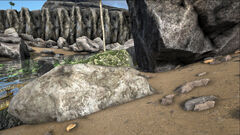
Common rocks with almost no metal at all
Note: When harvesting Metal you will want to use an Ankylosaurus, you can find these on every map in the game in various environments.
Leveling Up [ ]
- Every activity results in you gaining experience, even if it's simply not dying. Each level you gain will give you a single point to increase your attributes and a couple of Engram Points to unlock new crafting diagrams. Early on,
 Health and
  Fortitude are useful upgrades, keeping you healthy and more resistant to dinos and the environment longer. They also raise your resistance to losing consciousness.
 - For newer players it's easy to get caught up in the moment of having a lot of Health and/or a lot of
 Melee Damage or any other non-directly survival focused ability. With that said, be sure to plan ahead, by this I mean far ahead. Are you a crafter? Then perhaps
  Weight will be useful. Perhaps you like to tame dinosaurs? If so then investing some points into
  Stamina is a viable option, this will allow you to sprint and fight for longer durations. To stay longer under water and also to swim faster level up
  Oxygen.
 - Having around 200 Health, 180 Stamina and 120%
 Movement Speed is adequate to be able to stay on your toes even against a
  T-Rex.
 - To avoid being overburdened and carrying excess amount of resources, it is highly recommended to spend your skill points on only weight on levels 2-25, it will help tremendously in the future. After all, players in this game are building and carrying resources half the time, so having weight maxed or over 380 is extremely useful. It will prevent players from having to go back to base to dump all kinds of resources.
- Save your Engram Points after level 30 and only spend them when you come across something you need immediately. Higher level Supply Crates will provide you with many of the Blueprints for items that you would otherwise spend engram points on. Saving your engram points early on will enable you to make a more educated decision later in the game in regards to how you should spend them.
Gaining XP [ ]
- When you first spawn as a level 1 just craft several picks or torches to get the first few levels faster.
- Consider Note Runs, as they can grant massive amounts of XP in very short periods of time. A common Island Note run gets new characters from 1 - ~70 in less that 15 minutes, and is by far the best early game leveling tactic. Note runs exist for any map that has notes. (Extinction, Aberration, The Island, and Scorched Earth.)
- Craft Narcotic for easy experience (2xp per craft).
- If you can, killing a Rex can help a lot in gaining XP, or could be tamed easily once a player has enough meat, by standing on a high rock.
- Rafts give a lot of XP and are rather cheap once the player has a
 Metal Hatchet,
  Mammoth, Castoroides or Therizinosaur.
 - Killing simple dinos such as
 Trike gives a bit of XP, allowing higher tier players to farm XP fast, as these can easily be killed by guns.(shoot anywhere but the face as the Tirke takes reduced damage from projectiles there.)
 - Alphas provide a very good source of XP especially in the later stages of the game.
- Once it is craftable and if you meet the fairly steep initial resource requirement, the
 Industrial Grinder is a good way to consistently build up XP by grinding Stone into Flint if you spend a lot of time in your base.
 - Crafted to
 Element Shard in the inventory every
  Element Dust is worth 1 XP. Making it a considerable choice to level up especially at higher rates and with the help of Gachas and a Toilet.
 - Consider more aggressive methods of leveling such as clearing the Swamp Cave (The Island) for extremely fast leveling. Refer to the Swamp Cave or Leveling page for more info.
Taming [ ]
Summary [ ]
To tame most creatures you have to knock them out first. If you can craft them, it's highly recommended to use Bolas or make a trap to hold it in place while you knock it out with a torpor inducing method like Tranq Darts.Other creatures may be tamed passively by hand feeding them (like the  Mesopithecus), or require a completely different method (like the
  Troodon).
Creatures have a preferred type of  Kibble and food, either of which can be used to tame them - for example,
  Pulmonoscorpius and
  Araneo like
  Spoiled Meat. However, for most carnivores
  Raw Prime Meat, or
  Mejoberries for herbivores, can be also used instead, though they're not as efficient.
Taming creatures can take a long amount of time (up to several hours on official settings), make sure to minimize the amount of damage you do to the dinos when knocking them unconscious. Ideally, knock them out in as few hits as possible by using advanced methods like Tranquilizer Arrows or even Tranquilizer Darts. Doing damage to a dino after it is knocked out will reduce your taming effectiveness, decreasing the dinosaur's bonus levels gained after taming is complete and increasing the time to tame.
Note: Food draining (starving an unconscious dino before feeding it) does not actually reduce the time to tame, since the time it takes to drain food compensates for the time you save when feeding. The one exception is for fast spoiling food like Raw Prime Meat. Given its short spoil timer, if you have a bunch in storage (e.g. in a Preserving Bin or Refrigerator) starving the carnivore down enough to eat multiple Primes at once, will reduce loss. One method has been found to reduce tame times, it is linked as the following Taming#Taming Hints.
Keeping them Unconscious [ ]
Note taming effectiveness will drop if unconscious dino is hurt.
Console Commands [ ]
To open the console press Tab ↹ .
Source: https://ark.fandom.com/wiki/Tips_And_Tricks#:~:text=To%20get%20early%20meat%20and,to%20kill%20these%20small%20targets.
0 Response to "Easy Things to Kill on Ark Scorched Earth"
Post a Comment